
Paphos hard water: the full guide for pools and homes
Paphos tap water is hard — but not in the way that should scare you. Here's the science behind it, and why managing your pool is about LSI balance, not chasing low calcium.
15 June 2026
If you’ve recently moved to Paphos, Coral Bay, or Peyia, you’ve probably noticed it already. The kettle scales over within days. Shower glass turns cloudy. Skin feels drier than you’re used to. Pool owners hear stories about “ruined surfaces” from calcium and feel a flash of dread every time they look at a test strip. The local water authority will tell you this water is perfectly safe to drink — and that’s true. But its chemical composition has real consequences for what you build, heat, and swim in. This is a science-based guide to what’s actually going on, and what to do about it.
What “hard water” actually means
Water hardness isn’t about how the water feels — it’s about what’s dissolved in it. As rainwater passes through soil and rock, it picks up minerals, primarily calcium (Ca²⁺) and magnesium (Mg²⁺). The more of these it carries, the “harder” the water.
The World Health Organization classification, expressed as calcium carbonate equivalent (mg/L, which is the same as ppm):
- 0–60 ppm — soft
- 60–120 ppm — moderately hard
- 120–180 ppm — hard
- 180+ ppm — very hard
The WHO doesn’t set a health limit for hardness — calcium and magnesium are dietary essentials, and demineralised water has its own issues. What hardness does cause, above roughly 180–200 ppm in general engineering practice, is scale formation in plumbing, appliances, and heating elements. That’s why high-hardness areas are noticeable: scale on kettles, mineral spots on glass, shorter boiler life.
How hard is Paphos tap water, really?
Tap water in Paphos generally runs around 200–260 ppm calcium hardness — firmly in the “very hard” range, but not at the extreme end. Hardness can vary across Cyprus depending on source; what we measure in our Paphos work isn’t necessarily identical to Limassol, Nicosia, or rural borehole supplies.
And here’s an important distinction for pool owners: tap water hardness is just the starting point. Calcium hardness inside the pool can climb well beyond what came from the tap. Evaporation concentrates whatever minerals are already there — water leaves as vapour, calcium stays behind. On top of that, if calcium hypochlorite is used as a sanitiser, each dose adds calcium to the water. After a few seasons, it’s normal to see pools at 350–400 ppm or higher, even when the tap they top up with is at 220.
And here is the part that gets lost in most conversations about hard water: 200–400 ppm calcium hardness is the standard working range for pools across the global industry. It is not an anomaly, not a Cyprus problem, not a sign of bad water. Pool water is designed to carry that much calcium — and most pool surfaces, plaster, tile, and equipment are built around that assumption. Paphos pools sit at the lower end of this range when they come from the tap, and migrate toward the middle of it over a few seasons of normal operation. That is, by definition, normal pool water. The question is never “is calcium high?” — it is “is the water balanced?”
This is the moment when most owners panic and start asking about partial drains. Before doing anything, it’s worth understanding what calcium hardness actually does in a pool — because the answer isn’t “destroys it.”
Why the EU and Cyprus don’t regulate hardness
Under the current EU Drinking Water Directive, tap water at 350 ppm in Paphos is fully legal and officially certified safe to drink. The Water Board monitors the things that genuinely cause illness — bacteria, heavy metals, pesticides — and they’re strict about it. Hardness isn’t a public health issue, so it’s left to geology and to property owners.
The practical translation: protecting your appliances, plumbing, and pool from limescale is your responsibility, not the government’s. The good news is that the science is well understood, and the solution is much more elegant than draining your pool every summer.
The LSI principle: why high calcium isn’t the enemy
When Paphos pool owners see a calcium hardness reading of 400 ppm, the gut reaction is usually panic — expensive chemicals, partial drains, calls to multiple pool shops. That reaction comes from treating one number in isolation. Professional pool chemistry doesn’t work that way.
The metric that actually matters is the LSI — the Langelier Saturation Index — developed by chemist Wilfred Langelier in the 1930s and used today by Orenda Technologies and most serious pool chemistry programmes worldwide. The LSI combines six factors into a single number: pH, temperature, calcium hardness, total alkalinity, cyanuric acid, and total dissolved solids.
What that number tells you:
- LSI close to 0.0 — water is balanced; it neither dissolves nor deposits calcium
- LSI between -0.3 and +0.3 — considered safe and stable (Orenda’s working range)
- LSI below -0.3 — water is aggressive; it “wants” calcium and will take it from your surfaces, grout, plaster, and metal fittings
- LSI above +0.3 — water is scale-forming; calcium deposits on tile, in plumbing, on salt cells, and on heater elements
High calcium hardness isn’t inherently dangerous — what matters is whether the overall combination of variables keeps the water in balance.
Two contrasting scenarios — proven with real LSI math
Both scenarios below use values calculated through our Pool Health LSI calculator, with all other parameters held identical. Only calcium hardness changes.
Scenario 1: high calcium, perfectly balanced
Mid-summer Paphos pool. Water has been topping up from the tap and evaporating for months. Calcium hardness now sits at 400 ppm.
- Water temperature: 30°C
- pH: 7.7
- Total alkalinity: 90 ppm
- Calcium hardness: 400 ppm
- CYA: 40 ppm
- TDS: 1800 ppm
- LSI: +0.17 — within balance
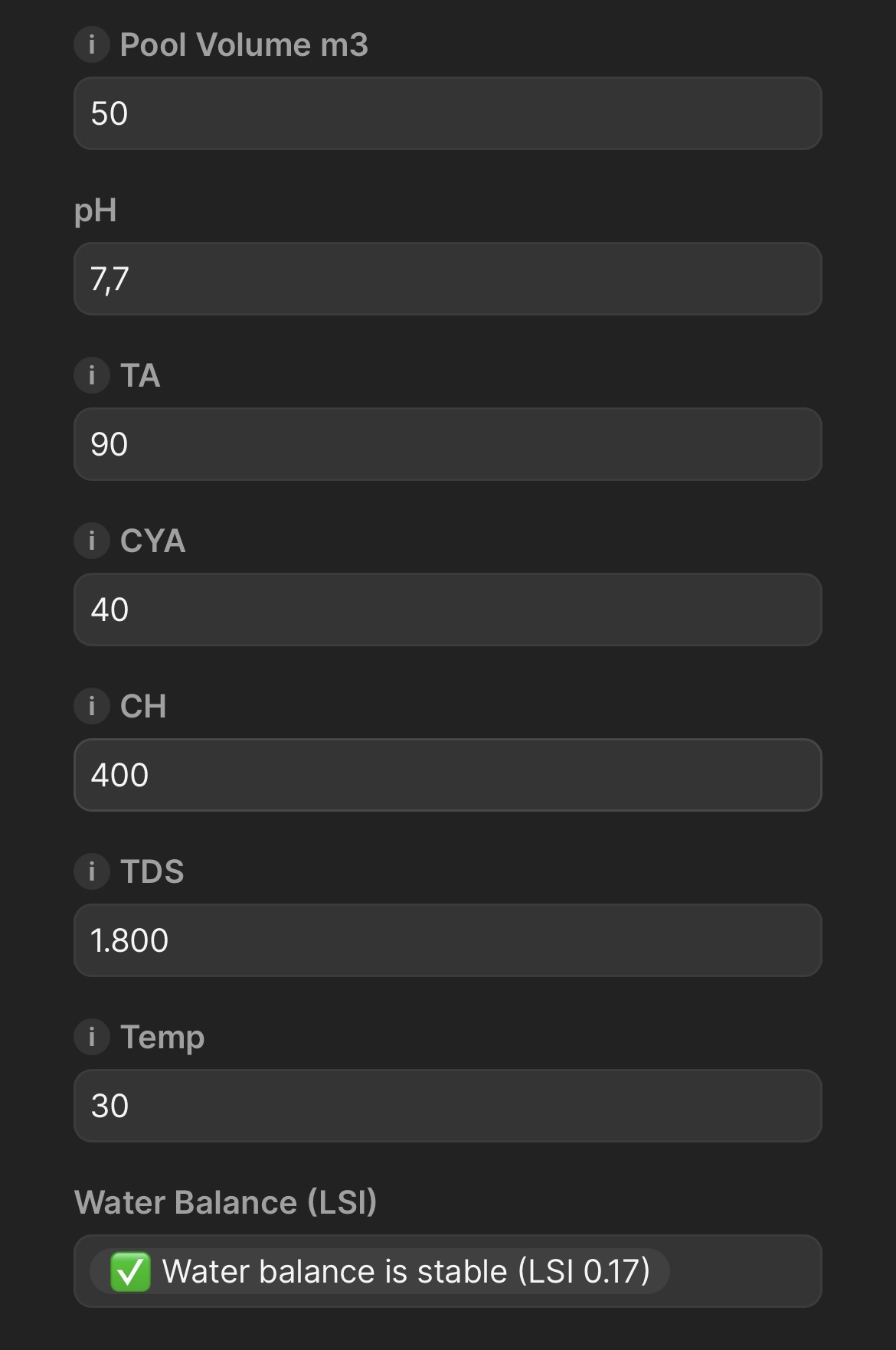
This pool is safe. Water isn’t attacking anything, and isn’t depositing calcium where it shouldn’t. The high calcium reading looks scary in isolation but is exactly counterbalanced by the other variables.
Scenario 2: low calcium, disaster in slow motion
Same pool, same temperature, same pH, same alkalinity, same CYA, same TDS. The only difference: calcium hardness has dropped to 50 ppm — perhaps because the pool was partially drained and refilled with low-mineral water, or because someone followed bad advice to “keep calcium low.”
- Water temperature: 30°C
- pH: 7.7
- Total alkalinity: 90 ppm
- Calcium hardness: 50 ppm
- CYA: 40 ppm
- TDS: 1800 ppm
- LSI: -0.75 — highly aggressive
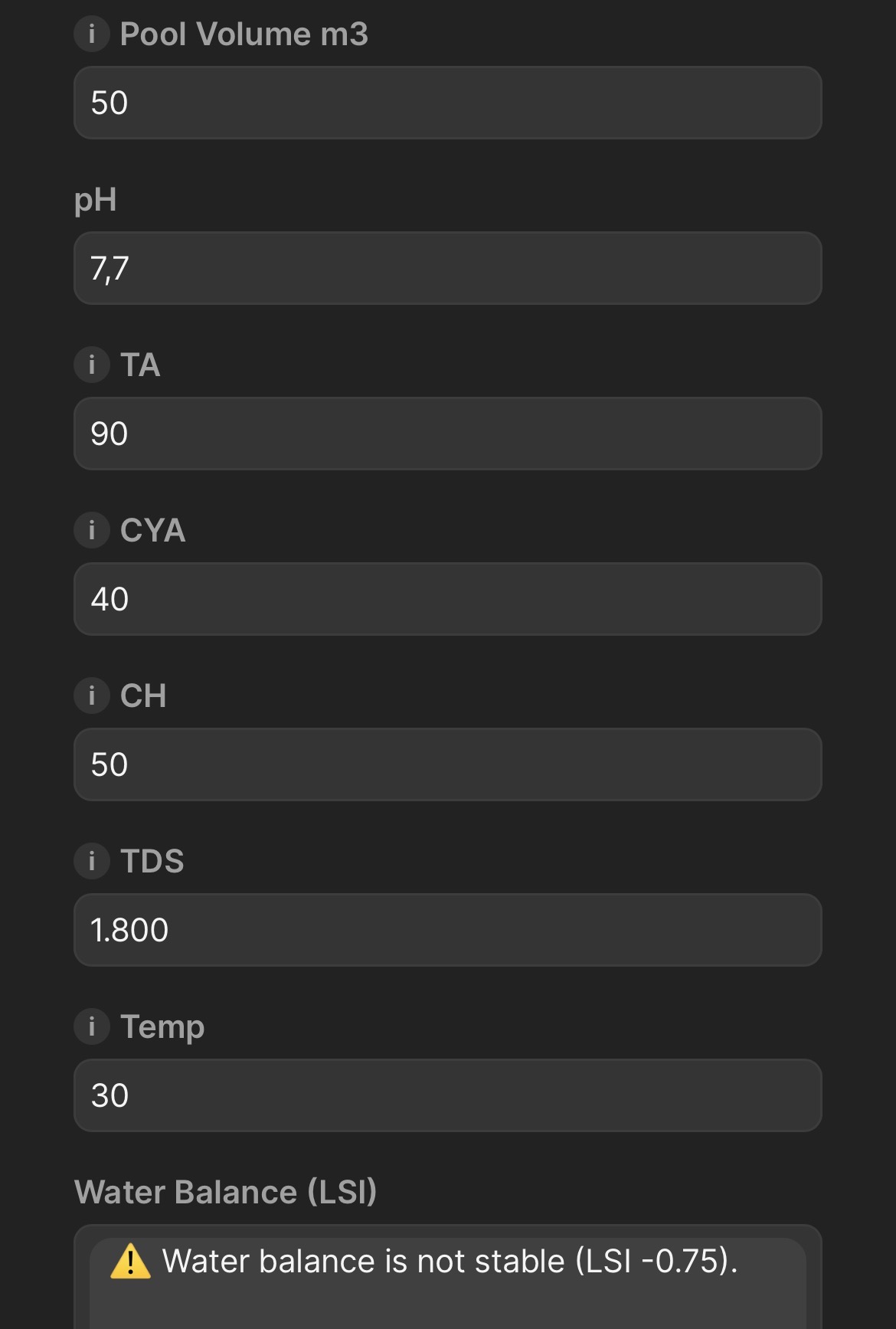
This water is starving for calcium, and it will take it from wherever it can. It dissolves tile grout. It pits plaster. It attacks stainless steel ladders and pump internals. Damage may not be visible for months, but it’s happening. By the time most owners notice, surfaces need professional restoration.
The lesson isn’t “keep calcium high.” The lesson is that calcium hardness in isolation tells you almost nothing. LSI is what determines whether your pool is safe. We’ve covered the science of how this plays out across surfaces in more detail in our piece on why calcium scale forms and why acid destroys pool surfaces.
Water always seeks equilibrium
There’s a deeper truth that every pool owner in Cyprus should understand. Water is constantly seeking equilibrium. It will always try to balance itself with what surrounds it.
Think of the water in the Asprokremmos or Evretou dams here in Paphos, or in any natural lake. In its native environment, that water sits in balance — it has had years to interact with the soil, the air, the surrounding rocks, the living organisms. It’s chemically at peace.
The moment that water is pumped into a private pool — isolated in a concrete box, heated by the sun, treated with chemicals, exposed to chlorine — the equilibrium it had is broken. Water doesn’t forget. It will try to find balance again, by whatever means available. If it’s overloaded with minerals, it dumps the excess as scale. If it’s starving, it takes minerals from your plaster, your grout, your equipment.
The owner’s job — or the maintenance provider’s — is to keep that equilibrium in the safe range, year-round, so the pool isn’t paying for it.
The seasonal challenge in Paphos
The LSI safe range (±0.30) sounds wide, but in Paphos it’s narrower than most owners realise, because conditions swing across the year.
In winter, water temperature can drop to around 10°C. Low temperature pushes LSI sharply negative — water becomes more aggressive even when pH and alkalinity haven’t changed. Pools that ran perfectly balanced all summer can quietly attack their surfaces all winter, if chemistry isn’t adjusted.
In summer, the opposite. High temperature pushes LSI up — and this is where things get interesting, because parameters compensate for each other in non-obvious ways.
Take the same pool at 30°C, CH 400 ppm, CYA 40, TDS 1800:
- At pH 8.0 with alkalinity at just 60 ppm, water still stays within the safe range. High pH on its own isn’t dangerous when low alkalinity counterbalances it.
- But if alkalinity climbs to 140–160 ppm, even at a “perfect” pH of 7.4, the balance tips into scale-forming territory. Despite the textbook pH reading, calcium starts depositing on salt cells, heater elements, and tile lines.
This is the key to understanding LSI: no single parameter works in isolation. Sun, heat, evaporation, and chemical drift all conspire to push the same pool through both ends of the range across the year. This is why a one-time chemistry setting doesn’t work — managing a Paphos pool well is a year-round rebalance, not a fix-and-forget.
What this means in practice
You don’t need to fear high calcium in your pool. You need to understand the system it’s part of.
- Stop reading calcium hardness in isolation. When all other parameters are balanced, a pool at 400 ppm CH can be safer than a pool at 150 ppm CH with low alkalinity and high pH. Calcium is only one variable in the LSI equation — read the whole picture, not the single number.
- Adopt an LSI-first mindset. Whether you use a test kit and online calculator, work with a service that does, or install monitoring with automatic dosing, the goal is the same: track LSI, not isolated numbers.
- Adjust for season. What’s balanced at 22°C isn’t balanced at 30°C — and definitely not at 10°C. Your chemistry needs to shift across the year.
- Be cautious about partial drains. A drain is sometimes necessary (very high CYA, mineral lockout, salt buildup), but it’s often the wrong reaction to a calcium reading that could be managed chemically. Draining and refilling restarts the problem, doesn’t solve it.
For Paphos pool owners who want this handled properly, our maintenance programme is built around year-round LSI balance, not a generic chemistry checklist. And for buyers evaluating a pool, our pre-purchase inspection guide covers how chronic mismanagement of LSI shows up in surfaces.
What about the house?
Hard water at home is a different problem with a different solution. The pool issue is about balance; the house issue is about removing scale-forming minerals from water that’s heated, sprayed, or left to evaporate on glass and fittings.
The standard solutions:
- Whole-house water softener — an ion exchange unit installed at the water entry to the house. It swaps calcium and magnesium for sodium, so the water that reaches your shower, washing machine, and boiler is functionally soft. Modern systems are reliable and need only occasional salt refills.
- Reverse osmosis (RO) at the kitchen tap — removes almost all dissolved solids, including the minerals that make water hard. Used for drinking water specifically.
One technical note on RO water that’s worth knowing. Pure RO water has very few dissolved minerals. The WHO has noted that water with extremely low mineral content may not be ideal for long-term consumption — calcium and magnesium in drinking water contribute, modestly, to dietary intake of these minerals. Many high-quality RO systems now include a remineralisation cartridge that adds back a controlled, healthy dose of essential minerals before the water reaches the tap. This is generally considered the better setup, especially for daily drinking water.
One other thing to flag, because it confuses people: very soft water feels “slippery” or “slimy” on the skin in the shower. That isn’t a sign the water is dangerous — it’s because soap reacts with calcium ions in hard water to form a residue, and without those ions, the soap rinses off more fully, which feels different. It’s a sensation, not a problem.
The summary
Living in Paphos means accepting that water is dynamic. The local tap is hard, your pool will trend harder than the tap over time, and your house appliances will pay the price if you do nothing. But “hard water” isn’t a verdict — it’s a condition, and one that’s well understood.
For your pool, the secret is LSI balance, not chasing low calcium. For your home, it’s targeted softening and clean drinking water. In both cases, the principle is the same: stop fighting the water, and start managing it.
Sources & references
- World Health Organization. Hardness in Drinking-Water: Background document for development of WHO Guidelines for Drinking-water Quality (2010). Source
- U.S. Geological Survey. Hardness of Water — Water Science School. Source
- Orenda Technologies. The LSI: how to know your pool water is balanced. Source
- European Union. Drinking Water Directive (EU) 2020/2184. Sets quality requirements for water intended for human consumption.