
Ideal pH for Cyprus Pools: Why pH Alone Isn't Enough
A real story from our first season — what we kept getting wrong, what the data eventually showed, and how the Pool Health system changed how we manage pool water.
18 June 2026
The official ranges, briefly
Pool chemistry in Cyprus is governed by the Swimming Pools Law of 2025, which sets the mandatory parameters every pool must operate within. The most directly enforced numbers are pH (7.20–8.00), total alkalinity (80–120 mg/L), free chlorine (1–4 ppm), and CYA (up to 100 ppm). The regulations focus on swimmer safety and disinfection effectiveness; calcium hardness and overall water balance are left to operator judgement — and that is where most of the actual work happens.
We always operate inside the regulated parameters. But staying inside them, year after year, in real Cyprus conditions, requires a way of working — not just a list of numbers to hit.
The problem we couldn’t explain
In our first season, we were doing everything by the book. We tested pH. We tested chlorine. We adjusted. We came back the following week and adjusted again.
pH kept climbing. Every week, without fail, the readings were high. We added acid. It came back up. We added more acid. Same result.
We were not making mistakes. The chemistry was not being neglected. But the water was not cooperating — and we didn’t fully understand why.
That’s when we started asking questions we hadn’t asked before.
Why pH naturally drifts upward
The first answer came from basic chemistry — specifically, Henry’s Law.
Henry’s Law describes how gases dissolve in liquids and how they escape. Carbon dioxide (CO₂) is naturally dissolved in pool water, and it plays a central role in pH stability. CO₂ in water forms carbonic acid, which keeps pH from climbing. But CO₂ is volatile — it wants to leave the water and return to the atmosphere.
Every time water is agitated — splashing, swimming, jets, waterfalls, even wind — CO₂ escapes. As it does, carbonic acid disappears, and pH rises. This is not a malfunction. This is physics.
In normal, well-managed pool water, pH wants to rise. This is not a sign that something is wrong. It is the natural direction of the system. If your pool’s pH is consistently low and needs to be raised, something unusual is happening — and that’s a different conversation.
Understanding this changed how we think about every pH reading we take.
Why pH alone is not enough
Even once we understood why pH drifts, we kept running into the same problem: pH alone wasn’t telling us enough. A reading of 7.8 could mean very different things depending on the temperature, the calcium content, the alkalinity, and what was dissolved in the water.
We needed a framework that looked at the whole picture — not individual numbers in isolation.
That framework already existed, and had for nearly a century: the Langelier Saturation Index (LSI), developed by water engineer Wilfred Langelier in 1936 and used today in municipal water treatment, industrial water systems, and the more rigorous corners of pool chemistry around the world.
We studied the methodology — including its modern interpretation for pool care by Orenda Technologies — and integrated it into how we work. The LSI is not a replacement for pH measurement. It is a calculation that puts pH in context.
LSI combines six parameters:
- pH
- Total Alkalinity
- Calcium Hardness
- Cyanuric Acid (CYA)
- Water Temperature
- Total Dissolved Solids (TDS)
The result tells you whether your water is balanced (LSI near 0.00), aggressive (negative LSI — water attacks surfaces and equipment), or scale-forming (positive LSI — water deposits calcium on surfaces, filters, and fittings).
We use a working range of −0.30 to +0.30. In Cyprus conditions — hard tap water, sustained high temperatures, intense evaporation — a pool sitting at LSI +0.4 is one weekend of wind and pH drift away from scaling. The tighter range gives us a buffer we’ve learned to need.
The point that most advice gets wrong
Here is what we learned, and what most pool advice still doesn’t say:
pH does not make water scale-forming. LSI does.
A pH of 7.8 is not inherently problematic. It only becomes a problem if the full LSI calculation — including temperature and calcium hardness — pushes the index into positive territory. Conversely, a pH of 7.4 can exist alongside a negative LSI if calcium hardness is low and temperatures are cold. That water is aggressive, even though the pH looks perfect.
We’ve written about this dynamic in detail in our piece on Paphos hard water and why high calcium isn’t the enemy. Tap water in Paphos generally runs around 200–260 ppm calcium hardness, but pools climb well above that over time through evaporation. Combined with summer temperatures past 30°C and the natural pH drift discussed above, the LSI in a Cyprus pool can move quickly — which is why managing pH alone means you may be constantly reacting to a symptom while the underlying imbalance continues undisturbed.
A note on HOCl and CYA — what matters for Cyprus outdoor pools
There is widespread advice that high pH is dangerous because it reduces the effectiveness of chlorine. The mechanism is real: as pH rises, free chlorine shifts from hypochlorous acid (HOCl — the active sanitising molecule) to hypochlorite ion (OCl⁻), which is far less effective.
The widely cited figures (calculated for 25°C, no CYA):
- At pH 7.4, roughly 62% of free chlorine is in the active HOCl form.
- At pH 7.8, that drops to around 33%.
This sounds alarming. But here is what that advice almost always omits: this relationship between pH and HOCl applies in this form only in the absence of cyanuric acid (CYA).
CYA — also called stabiliser or conditioner — is standard in every outdoor pool in Cyprus. It protects chlorine from UV degradation, but it also fundamentally changes the chlorine chemistry. In a CYA-dosed pool, the relevant metric is the FC/CYA ratio, not the HOCl-pH curve calculated for CYA-free water. The inhibitory effect of cyanuric acid on chlorine disinfection has been documented in peer-reviewed literature since at least 1967 (Robinton & Mood, American Journal of Public Health), and the foundational chemistry was reviewed by Canelli in 1974. The underlying equilibrium that supports the modern FC/CYA ratio approach was quantified by O’Brien, Morris and Butler in their 1974 work on chlorinated isocyanurate equilibria, and the practical ratio framework has been developed and refined through subsequent decades by industry researchers and the Council for the Model Aquatic Health Code (CMAHC).
This is why our tracking system uses one combined metric — what we label %HOCl(2025) in our data is our FC/CYA calculation, which gives the genuinely active chlorine percentage for a stabilised pool. We covered the mechanics in our piece on why chlorine “stops working” in Cyprus pools.
In practical terms: for outdoor pools in Cyprus with normal CYA levels, the concern about pH at 7.8 reducing HOCl is significantly overstated. If LSI is balanced and the FC/CYA ratio is correct, a pH reading near the upper end of the working range is not a crisis. It is normal pool water doing what pool water does.
“But high pH irritates eyes and skin” — does it?
This is one of the most persistent myths in pool management. If swimmers are experiencing eye irritation, red skin, or discomfort, the instinct is to blame pH. But in a properly chlorinated pool, these symptoms are almost never caused by pH in the normal working range.
The real culprit is almost always chloramines — compounds formed when chlorine reacts with nitrogen from sweat, urine, and other organic matter. Chloramines are irritating, they smell, and they are a sign of chlorine demand, not high pH. The role of chloramines in pool-related irritation is well-established in modern pool chemistry literature.
If your swimmers are uncomfortable, check combined chlorine (chloramines) before reaching for acid. A pH of 8.0 with zero chloramines is a more comfortable pool than a pH of 7.4 with high combined chlorine.
Individual sensitivities can of course vary, and persistent symptoms warrant a conversation with a medical professional. What we’re describing here is the typical pattern, not a universal rule.
This is exactly the kind of distinction that gets lost when you manage water by individual numbers rather than as a system.
Our data: before and after the Pool Health system was fully applied
These are real measurements from one of our client pools. Same pool, same tracking system, two different periods.
Before the system was fully applied
In the early phase of monitoring, we were tracking pH and acid additions but not yet calculating LSI consistently. During this period:
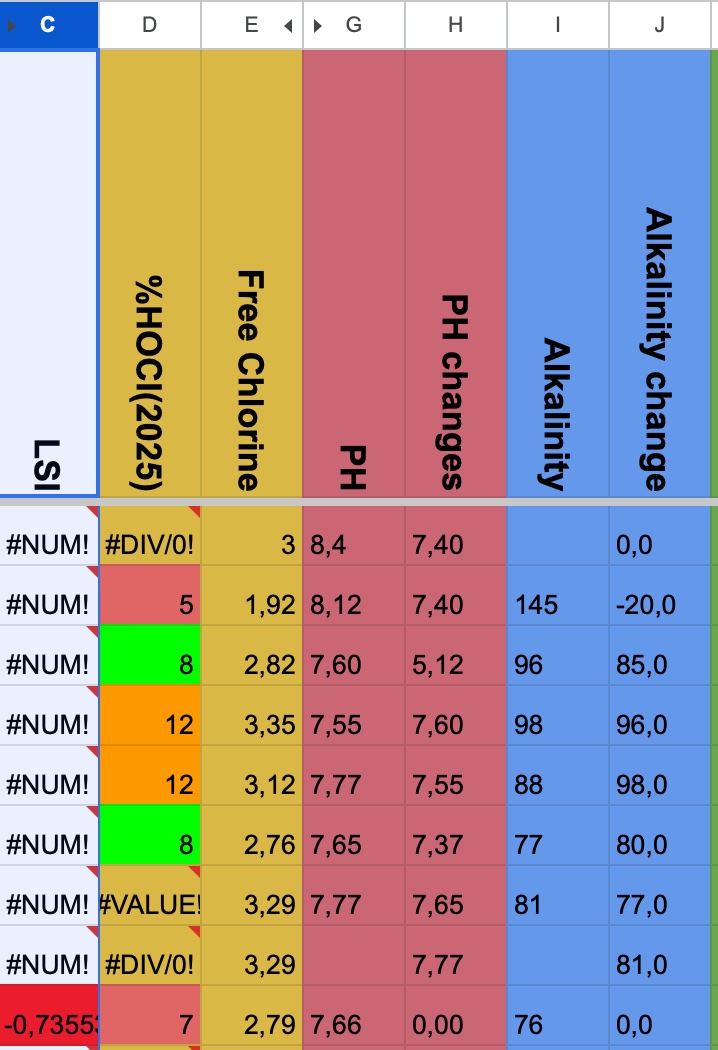
What the data shows: pH readings ranged from 7.40 to 7.83 across consecutive visits. Hydrochloric acid was added on most visits. The water was being managed reactively — we responded to what the pH meter showed, without the full LSI context that would have told us what was actually driving the readings.
After the system was fully applied
Once all parameters were tracked and LSI was functioning, and we were managing the pool as a system rather than reacting to single numbers:
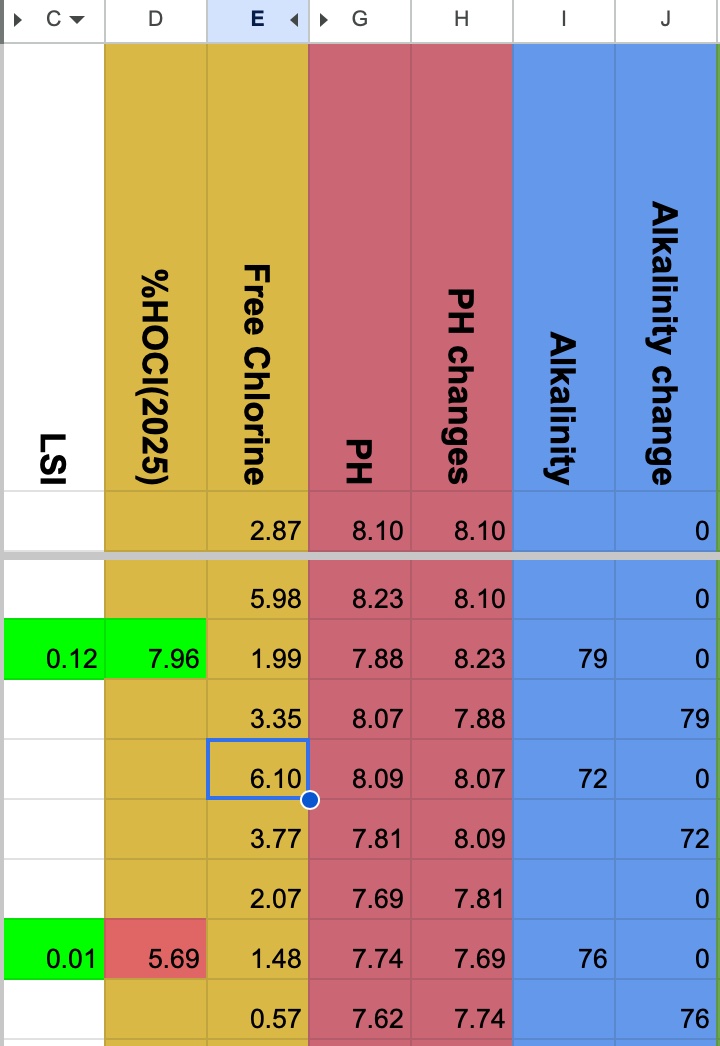
What the data shows: LSI readings between −0.16 and +0.16 — all comfortably inside our ±0.30 working range. pH stabilised between 7.75 and 8.09 across eight consecutive weekly visits, and no acid additions were needed. The water reached its own equilibrium and stayed there.
This is what working with water — instead of fighting it — looks like.
So what is the ideal pH for a Cyprus pool?
The honest answer: there isn’t one fixed number. The regulated range of 7.20–8.00 is a sensible legal boundary. But the right pH for your pool on any given day is the pH that, together with calcium hardness, alkalinity, temperature, and CYA, keeps your LSI balanced. That might be 7.4 in one pool and 7.9 in another — both correct, and both well inside the legal range.
In Cyprus conditions, the pH number alone will mislead you. What matters is the whole picture:
- Is LSI in range (±0.30)?
- Is the FC/CYA ratio appropriate for the bather load and UV exposure?
- Is pH drifting up naturally (expected and manageable) or being pushed in an unusual direction?
- Are you managing the water, or reacting to it week after week?
A pH of 7.9 with LSI at 0.05 is better-managed water than a pH of 7.4 with LSI at +0.7. The number is not the answer. The system is.
What we do differently
At Pool Health, every pool visit includes:
- Photometric analysis (not test strips)
- Full LSI calculation incorporating temperature, CYA, calcium hardness, and TDS
- FC/CYA ratio (the genuinely active chlorine percentage — what we track as %HOCl in our system)
- Weekly data logged and trended over time
We don’t just take readings. We maintain a water history for each pool — because water chemistry is not a snapshot, it is a story. Understanding the story is what allows us to stop reacting and start managing.
If you’d like a chemistry audit for your pool, our full-scope inspection service covers all of the above and gives you a written report. For ongoing care, see our maintenance programme.
Frequently asked questions
Sources & references
- Republic of Cyprus. The Swimming Pools Law of 2025 and accompanying regulations. The legal framework for pool water quality in Cyprus, effective July 2025. Covered in more detail in our blog post on Cyprus pool law 2025.
- World Health Organization. Guidelines for Safe Recreational Water Environments, Volume 2: Swimming Pools and Similar Environments. Geneva, 2006. The principal international reference document for swimming pool water quality, hygiene, and operational safety. Used as a foundational reference by national and regional regulators across Europe, including Cyprus. Source
- European Committee for Standardization (CEN). EN 15288-2: Swimming pools for public use — Safety requirements for operation. The primary European technical standard for the operational safety of public swimming pools, referenced directly in Cypriot pool legislation.
- Robinton, E. D., & Mood, E. W. (1967). An evaluation of the inhibitory influence of cyanuric acid upon swimming pool disinfection. American Journal of Public Health, Vol. 57, No. 2, pp. 301–310. The earliest peer-reviewed quantification of cyanuric acid’s inhibitory effect on chlorine disinfection in pool water.
- Canelli, E. (1974). Chemical, Bacteriological, and Toxicological Properties of Cyanuric Acid and Chlorinated Isocyanurates as Applied to Swimming Pool Disinfection: A Review. American Journal of Public Health, Vol. 64, No. 2, pp. 155–162. The foundational review of cyanuric acid chemistry in pool water, still cited in modern guidance.
- O’Brien, J. E., Morris, J. C., & Butler, J. N. (1974). Equilibria in Aqueous Solutions of Chlorinated Isocyanurate. In A. J. Rubin (ed.), Chemistry of Water Supply, Treatment, and Distribution (1973 Symposium), Ann Arbor Science Publishers, pp. 333–358. The original quantification of the chlorine–CYA equilibrium that underpins the modern FC/CYA ratio framework.
- Wojtowicz, J. A. (2001). Effect of Cyanuric Acid on Swimming Pool Chemistry. Journal of the Swimming Pool and Spa Industry. Detailed analysis of the FC/CYA equilibrium and its implications for disinfection.
- Langelier, W. F. (1936). The Analytical Control of Anti-Corrosion Water Treatment. Journal AWWA, Vol. 28, No. 10. Original formulation of the Langelier Saturation Index, still in use in water engineering worldwide.
- Orenda Technologies. The Langelier Saturation Index Explained. Modern interpretation of LSI methodology specifically for pool care. Source